Spotting Service Gaps Your Competitors Miss
Finding the Weak Spots in Local Markets
Every business watches its competitors, but most watch the same things: price, product features, and marketing spend. That narrow view leaves a lot of ground uncovered. The real opportunity lies in what competitors are not doing - the service gaps they overlook because they are looking in the wrong direction. With the right approach, you can identify those gaps and position your business where demand exists but supply is thin.
Competitor intelligence software makes this kind of analysis practical at scale. Instead of manually checking a handful of rivals each month, you can monitor signals across dozens of competitors, across multiple locations, and spot patterns that would otherwise stay hidden. The trick is knowing which signals matter and how to interpret them.
Step 1: Map the Full Competitor Landscape
Most businesses focus on direct competitors - companies that offer the same service to the same audience. That is a good starting point, but it is not enough. Service gaps often appear where indirect competitors operate. A local coffee shop might see another coffee shop as its main rival, but the real gap could be in the way a nearby bakery offers takeaway pastries with faster service. The competitor research should include any business that solves a similar customer need, even if the solution looks different.
Use competitor intelligence software to pull a broad list of businesses that rank for the same search terms your customers use. Filter by location, service type, and customer rating. Look for businesses that appear in local search results but do not match your exact category. These are the ones that might be serving your potential customers without you noticing.
What to watch: businesses that appear in search results for terms related to your service but are not direct competitors. For example, a plumbing company might find that handyman services rank for "leaky faucet repair." That is a signal that customers are looking for quick fixes, not full-scale plumbing work. If your competitors only offer full-day appointments, a same-day handyman service fills a gap you could address.

Step 2: Analyse Customer Reviews Across Competitors
Customer reviews are a goldmine of information about service gaps. People are quick to complain about what they did not get, and those complaints reveal exactly what competitors are failing to provide. The challenge is sifting through hundreds or thousands of reviews manually. Competitor intelligence software can aggregate reviews from multiple platforms and highlight recurring themes.
Look for phrases like "I wish they had," "It would be better if," or "They didn't offer." These are direct expressions of unmet needs. Also note compliments that contrast with what competitors do: "The staff was friendly, but the wait was long" points to a speed gap. "Great product, terrible parking" points to an accessibility gap. Every review contains a piece of market positioning data if you know how to read it.
What to watch: patterns in negative reviews that your competitors share. If three competitors all get complaints about slow response times on weekends, that is a gap you can fill by offering weekend availability. If customers consistently mention poor communication after a service is booked, that is a gap in follow-up that you can address with automated updates.
Step 3: Examine Search Visibility Gaps
Search visibility tells you which services competitors are actively promoting and which they are ignoring. A competitor that ranks well for "emergency plumbing" but not for "plumbing maintenance" is leaving a gap in the maintenance market. You can identify these gaps by comparing the search terms your competitors rank for against the terms your target audience uses.
Competitor intelligence software can show you the keywords each competitor ranks for, their estimated traffic, and how their rankings have changed over time. Look for high-volume terms that none of your competitors appear for, or where only one or two competitors rank. Those are the service gaps waiting to be filled.
What to watch: keywords that have low competition but high relevance to your service. Also watch for seasonal gaps. A competitor might rank well for "Christmas tree delivery" in December but have no presence for "tree recycling" in January. That is a gap you can own with a simple service extension.
Real time competitive market insights give you the ability to see these shifts as they happen, not weeks later when the opportunity has passed.
Step 4: Look at Pricing Signals
Pricing is a direct reflection of how a competitor positions itself. But pricing signals go deeper than the price tag. They tell you what services competitors value and which ones they treat as an afterthought. A competitor that charges a premium for basic work but offers discounts on add-ons is signalling that the basics are their core business and add-ons are a way to upsell. If customers consistently buy the add-ons but complain about the base service, there is a gap in quality at the entry level.
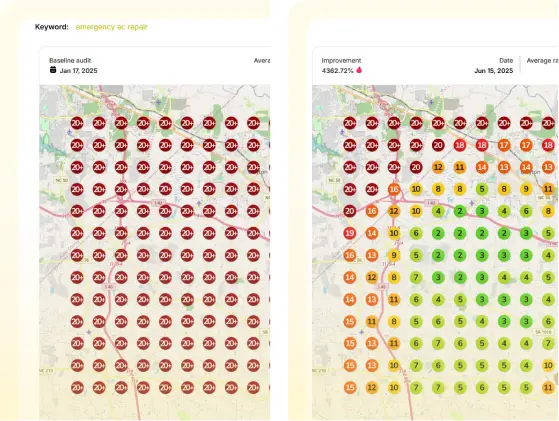
Competitive benchmarks help here. Compare the pricing structure of multiple competitors for the same service. Look for services that are priced inconsistently across the market. If one competitor charges twice as much as others for the same work, customers may be paying for a premium that does not exist, leaving a gap for a transparent, fairly priced alternative.
What to watch: services that are missing from competitor price lists entirely. If no local competitor offers a specific service type, that is a gap. Also watch for pricing that is too high or too low compared to the market average. Both extremes signal an opportunity - either to offer a mid-range option or to enter a segment where competitors have misjudged demand.
Step 5: Monitor Local Competitors for Behavioural Gaps
Local competitors often have the most to gain from service gaps because they operate in the same physical area. A gap that exists across multiple local competitors is almost certainly a real market need. Use competitor intelligence software to track local competitors' behaviour over time: how often they post on social media, how quickly they respond to reviews, whether they update their website content, and which services they promote most heavily.
A local competitor that never responds to reviews is leaving a gap in customer engagement. A competitor that only posts about product launches but never about customer education is leaving a gap in trust-building. A competitor that has not updated its service list in six months may be missing new customer needs entirely.
What to watch: any behaviour that is consistently absent across multiple local competitors. If none of them offer online booking, that is a gap. If none of them provide after-hours support, that is a gap. If none of them publish case studies or customer stories, that is a gap in social proof that you can fill.
Step 6: Act on the Gaps You Find
Identifying gaps is only half the work. The other half is figuring out which gaps are worth filling. Not every gap represents a viable business opportunity. Some gaps exist because the demand is too small, the logistics too complex, or the profit margin too thin. Use the data you have gathered to prioritise gaps based on three factors: the size of the unmet demand, the ease of filling the gap with your existing resources, and the potential for differentiation from competitors.
Real time competitive market insights help you validate your assumptions quickly. If you decide to offer a new service based on a gap you found, you can monitor competitor reactions and customer uptake in near real time. That allows you to adjust your approach before committing significant resources.

What to watch: gaps that align with your existing strengths. If you have a strong team of technicians, a gap in maintenance services is more promising than a gap in consulting. If your brand is known for speed, a gap in emergency response is a natural fit. The best gaps are the ones that play to your advantages while your competitors remain stuck in their old patterns.
Making It a Habit
Service gaps shift as competitors adapt and customer expectations evolve. A gap that exists today might close next month when a competitor adds a new service line. That is why ongoing monitoring matters more than a one-time analysis. Competitor intelligence software makes it possible to track changes continuously, so you are always aware of new openings before your competitors fill them.
The businesses that win are not the ones with the most features or the lowest prices. They are the ones that see what others miss and act on it first. By systematically looking for service gaps through competitor research, customer reviews, search visibility, pricing signals, and local competitor behaviour, you put yourself in a position to capture demand that your rivals have left on the table.